


Access to clean water is essential for every household. In Malaysia, municipal tap water is treated to meet the National Drinking Water Quality Standards (MOH) and largely aligns with the World Health Organization (WHO) Drinking Water Guidelines. However, even treated tap water may still carry impurities such as sediments, rust, chlorine and organic residues by the time it reaches your home.
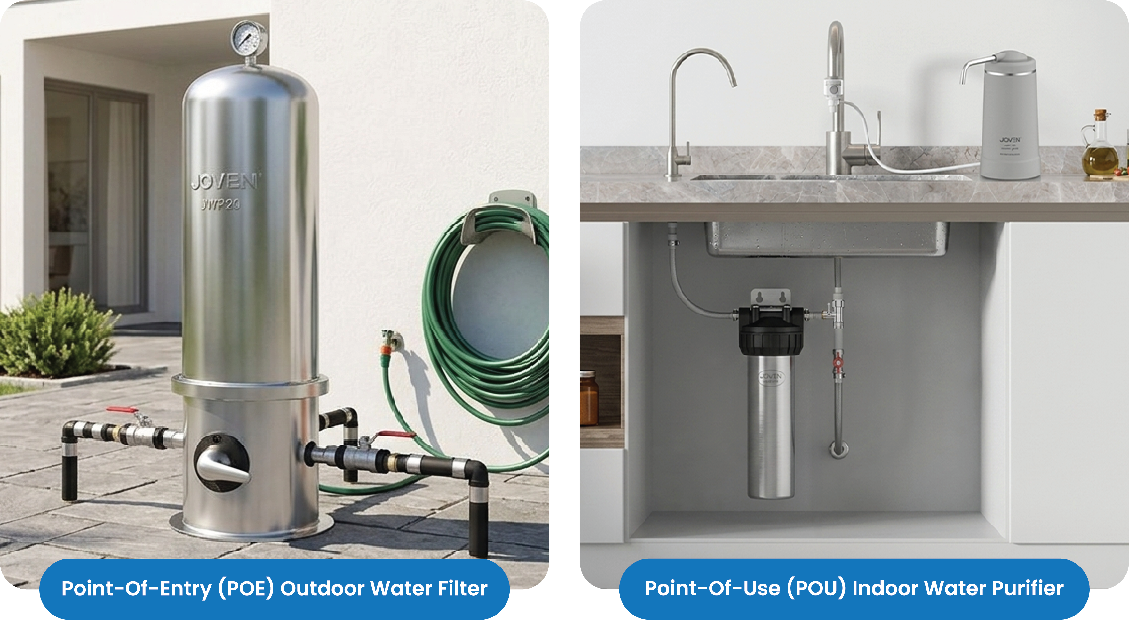
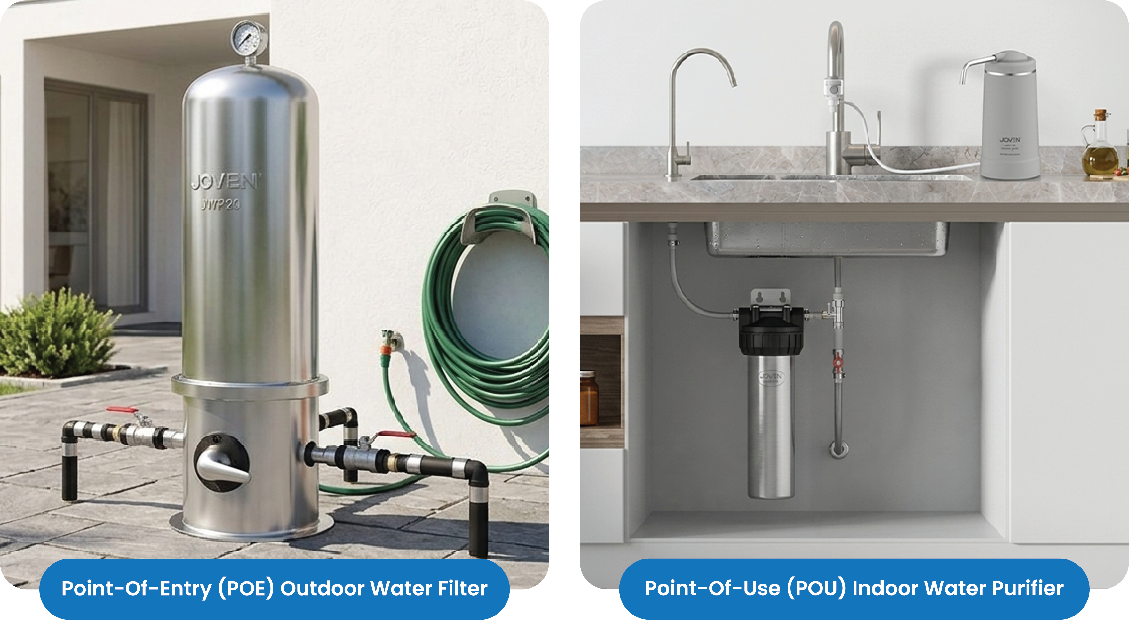
To ensure safer, better-quality water for daily use, homeowners should adopt a comprehensive water treatment approach. This typically involves using both a Point-of-Entry (POE) water filter and a Point-of-Use (POU) water purifier system to cover all household water needs—from general washing to drinking and cooking.
This article explains the difference between water filtration and purification, and why installing a POE and POU system can make a significant difference for your home.

Understanding Water Filtration
Water filtration involves physically or chemically removing impurities by passing water through a filtration medium. The goal is to eliminate contaminants such as:
✅ Sediment (sand or dirt)
✅ Visible particles
✅ Rust and deposits from pipelines
✅ Chemical such as chlorine, heavy metals and etc
✅ Smaller pathogens such as amoeba, bacteria or viruses
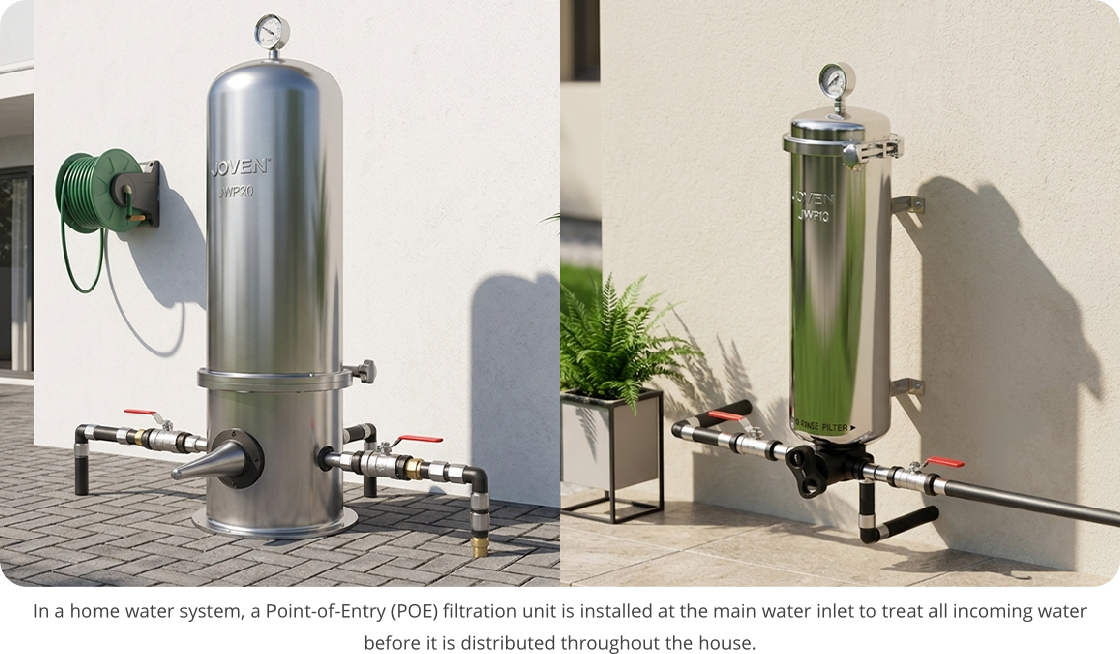
A POE filtration system like the Joven JWP20 and JWP10 is designed to:
✅ Remove harsh particles such as microsand, dirt, sediments and rust from the incoming water supply
✅ Retain chlorine, which is important for maintaining disinfection as water travels through household plumbing and ending up in a water tank or storage area.
This filtration process improves the overall water quality for general household activities such as bathing, washing clothes, cleaning and water storage. It ensures that water is visually cleaner and free of debris while still meeting basic microbial safety requirements set by public health standards.
It is important to note that water filtration at the POE level focuses mainly on physical impurities. It does not specifically remove chlorine, dissolved chemicals, bacteria or viruses.
Understanding Water Purification
Water purification targets a broader range of contaminants, aiming to improve water safety and quality specifically for direct consumption, such as drinking and food preparation. Installed at individual taps, typically in the kitchen, Point-of-Use (POU) purification systems such as the JP310 and JP210 are designed to:
✅ Remove bacteria, viruses, chlorine, odours and unpleasant taste.
✅ Filter out finer impurities like organic compounds, heavy metals and microplastics can be removed with a water purifier of 0.05 - 0.1 Micron level.
✅ Enhance the overall safety and taste of water for drinking, cooking and washing food. Water purification complements the initial filtration by addressing contaminants that are not typically removed at the Point-of-Entry.
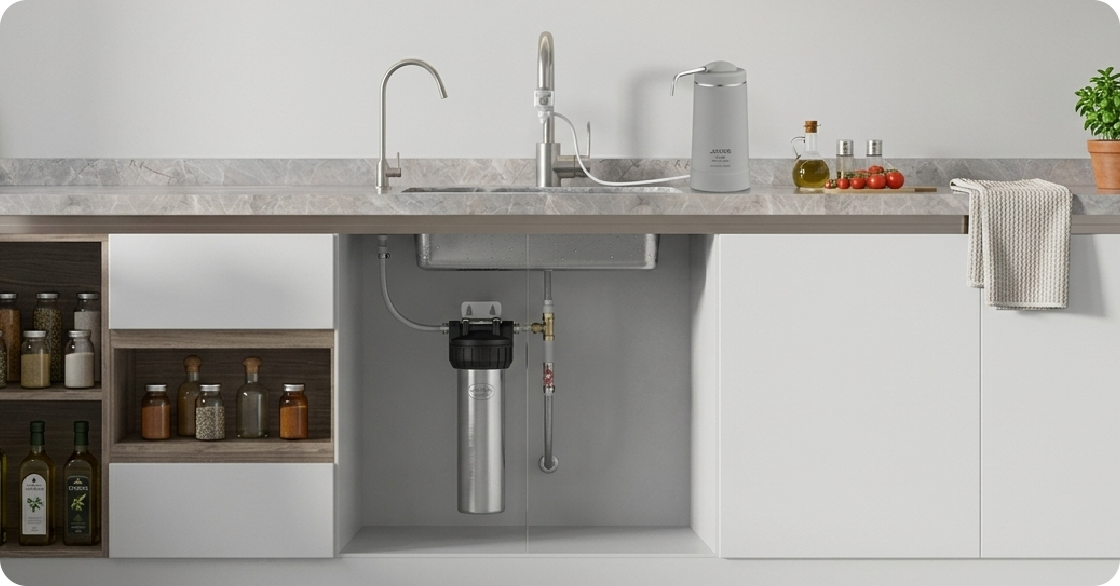
It is particularly valuable for households that want higher-quality drinking water that meets both safety and health standards
beyond the basic requirements of tap water. Unlike POE filtration systems, POU purification units focus on fine filtration and chemical removal, making the water safer and more pleasant for direct human consumption.
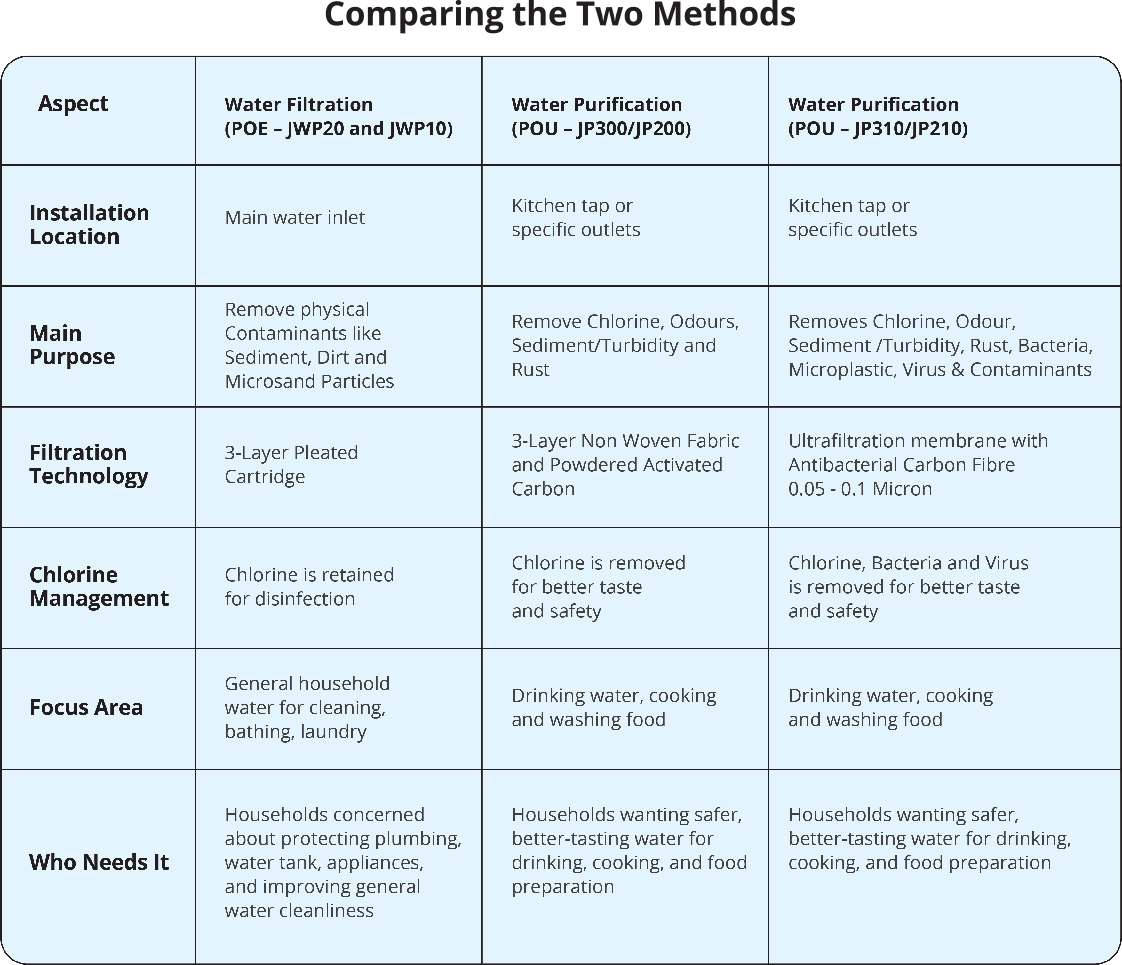
Key Differences Between Filtration and Purification
While both water filtration and water purification contribute to improving household water quality, they serve distinct roles within a complete water treatment system. Water Filtration at the Point-of-Entry (POE), such as using the JWP20 and JWP10, focuses on:
- Removing larger, visible impurities such as sand, sediments and dirt.
- Retaining residual chlorine to maintain disinfection throughout the plumbing system.
- Enhancing the general quality of water used for bathing, laundry, cleaning and household chores.
This ensures that all water entering the home is cleaner and protects plumbing fixtures, water tank and household appliances from damage caused by a particular buildup.
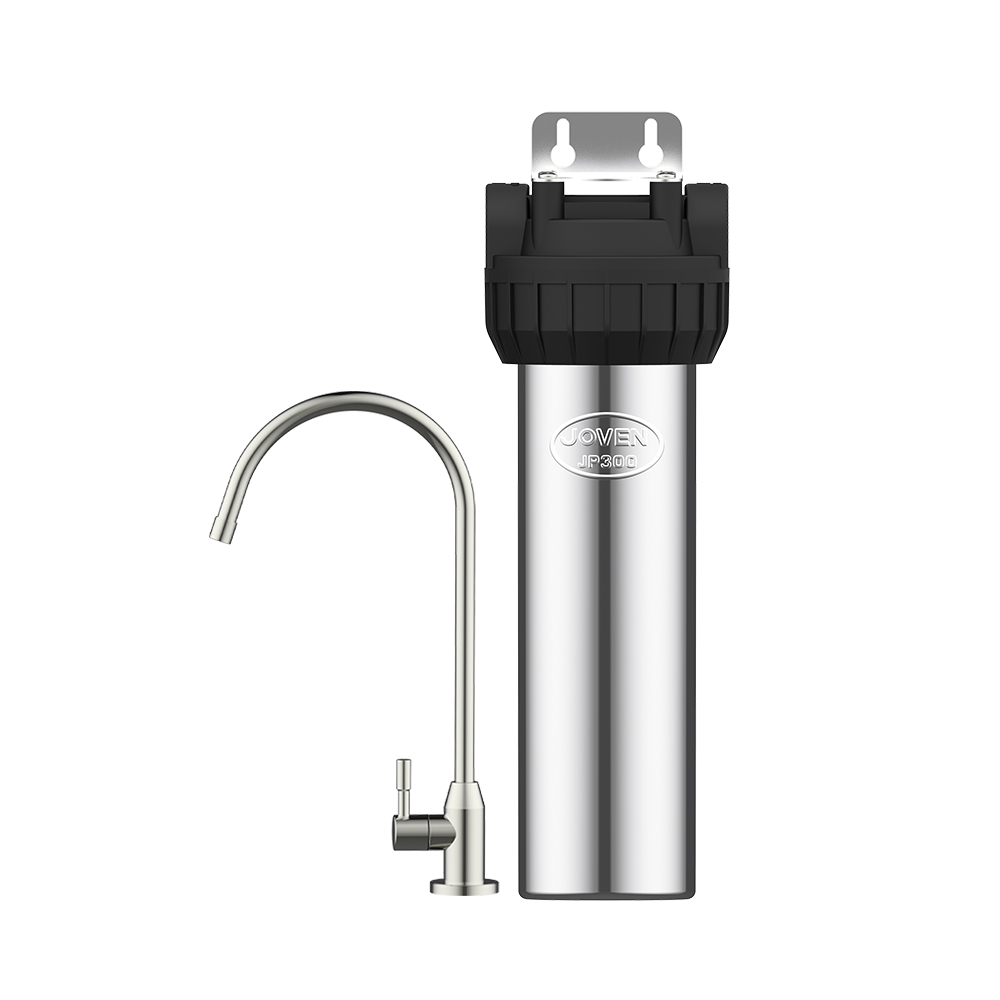
Water Purification at the Point-of-Use (POU), such as with the JP300 or JP200, provides an additional layer of treatment with powdered activated carbon or JP310 and JP210 with ultrafiltration and antibacterial carbon membrane by:
- Removing chlorine, odours, fine sediments and organic compounds.
- Removing microplastics, bacteria, microorganisms, viruses for purification up to 0.05 - 0.1 Microns with ultrafiltration
- Improving the taste, smell and overall safety of the water specifically used for drinking and food preparation
Purification ensures that water consumed by the household meets higher safety and quality standards, addressing both health and safety concerns at the point of use.
Choosing What’s Right for You
Selecting between water filtration and purification — or combining both — depends on several important factors, including your water source, health priorities and household needs. Here are a few guiding questions to help determine the best solution:
Do you know what’s in your water?
If you're uncertain, it’s advisable to conduct a water quality test.
Testing can reveal the presence of:
- Sediments (Sand, Rust and Dirt)
- Residual Chlorine
- Microorganisms (Bacteria and Viruses)
- Minerals in water
Understanding the specific contaminants present in your water helps in selecting the right system — whether a basic filtration system is sufficient or if a purification step is necessary.
Municipal tap water in urban areas is generally treated and monitored. However, it may still carry residual chlorine, dirt, sediment, rust or odour issues. In such cases, a POE filtration system combined with a POU purification unit enhances water quality and safety.
Preservation of minerals within tap water
Filtration systems typically retain naturally occurring minerals such as calcium and magnesium, which are important for overall health. Purification systems — particularly Reverse Osmosis (RO) — tend to remove minerals along with contaminants which is not recommended for daily consumption. Long term consumption of RO water leads to mineral depletion within the body.
Some systems include remineralization stages to add essential minerals back into the purified water for better taste and health balance however requiring extra costs of remineralisation cartridges. For daily consumption a purification system that strips off the unwanted compounds within water yet retain the essential minerals within water is always recommended for better health.
What is your budget and maintenance preference?
Filtration systems (e.g., POE filters) usually have lower upfront costs and simpler maintenance, requiring periodic cartridge replacements. Sandfilters, the traditional filtration system may involve a lower cost but is less efficient filtering up to 10 Microns and require periodic change of sand within the filter compared to a 3-Layer Pleated Cartridge that can filter up to 5 Microns with a cartridge that is backwashable and change of cartridge only required after 2-3 years.
Purification systems (e.g., RO or UV systems) have higher initial investment and involve maintenance activities such as membrane flushing, UV lamp replacement, system cleaning, change of multiple cartridges.
Joven Filters and Purifiers are the best choice for an affordable yet effective filtration and purification for your everyday household needs with an effective single cartridge system for ease of maintenance for daily use to remove unwanted contaminants within water without stripping the essential minerals from water.
A Combined Approach for Best Results
For many households, combining both filtration and purification offers the most comprehensive protection:
- A POE filtration system (such as Joven JWP20 and JWP10) ensures that all incoming water is free from sediment, rust and larger impurities.
- A POU purification system (such as Joven JP300, JP310, JP210 or JP200) ensures that water used for drinking and food preparation is clean, safe and great-tasting.
Final Thoughts
Choosing the right water treatment solution for your home begins with understanding the different roles that filtration and purification play.
While Malaysia's municipal tap water meets national and WHO standards for basic safety, additional steps at the household level can further enhance water quality — improving both health protection and everyday comfort.
A Point-of-Entry (POE) system provides essential filtration by removing larger contaminants like sediment and dirt, safeguarding the quality of water used throughout the home for cleaning, bathing and washing. Meanwhile, a Point-of-Use (POU) system focuses on refining water at specific outlets, ensuring that the water you drink and cook with is free from chlorine, odours, heavy metals and fine impurities.
By combining both POE and POU systems, homeowners can achieve a complete and effective approach to home water management — protecting plumbing systems, water tank, removing contaminants from water, enhancing taste, removing odour and providing greater peace of mind about water safety.
For those seeking reliable solutions tailored for Malaysian conditions, Joven Malaysia offers a comprehensive range of systems.The Joven JWP20 and JWP10 serves as an effective POE water filter, while the Joven JP300, JP310, JP210 and JP200 provide high-quality POU purification options — ensuring cleaner and safer water for every part of your home.